Survivor Story
My Body Remembers
No one warned me about the moment when the past stops behaving like the past. It returns quietly, not as memory, but as something alive beneath my ribs.
For years, I pointed to my life as proof that I’d outrun it. I worked harder than most people around me. Not from ambition, but because competence felt like armor. If I stayed useful, no one could discard me. I became the person who handled everything and needed nothing. I climbed out. I built something that looked solid.
Or I thought I did.
Growing up with long-term trauma meant I adapted instead of moving on. Silence kept me safe. Being “strong” or “fine” wasn’t a personality trait. It was survival. So when I finally chose to speak up, to say aloud, “This doesn’t feel okay”, my body reacted as if I’d stepped into open flame. My voice shook. Every cell insisted danger was coming. But I said it anyway. That cost something real.
When that hard-won opening met minimization instead of care, something old stirred awake. I spoke. I wasn’t protected.
Sometimes the trigger is small. A comment that brushes my pain aside, a choice where someone values optics over my well-being. It lands fast, like an elevator cable snapping. And then the voice rises, quiet, certain: See? You were never enough. In the moment, I can’t argue with it.
Trauma rarely returns as memory. It returns as certainty. Certainty that I am not enough. Certainty that the foundation was always fragile.
From the outside, nothing looks broken. My husband moves toward me with steady hands and warm eyes. But internally, a beam has snapped. I know this place. I thought I’d left it behind. Realizing I haven’t carries its own quiet devastation.
What keeps me upright now isn’t the career or the hard-won identity. It’s my husband’s grounding presence and my son’s small hand gripping mine. They hold the line when everything else shakes.
My son is where the sharpest ache settles. I know what it’s like to carry these wounds into adulthood, to patch yourself together with competence and hope no one notices the seams. I fear him one day sitting where I sit now. That fear, born from love, is one of the most human things in me.
There’s a specific kind of hurt that comes from believing someone would protect you, and finding out they won’t. For someone who grew up without protection, trust was never just trust. It was a test. Every relationship carried a question underneath: will someone choose me this time? Will I matter enough to be protected?
When the answer is no, it doesn’t feel like a setback. It lands like evidence. The past and present collapse into each other, and suddenly I’m not facing one wound. I’m facing all of them at once.
I keep things close because once, vulnerability carried consequences. So when I finally let someone in and that trust fractures, my nervous system doesn’t read it as a small mistake. It registers it as confirmation. And when someone does defend me, openly, firmly, that too is disorienting. The emotional shock of someone choosing me lodges somewhere deep.
Then there’s the anger. Watching someone manage the optics of my pain instead of responding to it. Hearing praise for my contributions while receiving decisions that cut into me. Beneath the anger is a quieter longing: not only to be seen as capable, but to be treated as someone worth protecting.
To feel “broken” here doesn’t mean beyond repair. It means questioning whether I’ll ever feel steady again. It means wondering if I have the strength to speak up after the last attempt cost so much. It isn’t a loss of ability. It’s a loss of felt safety.
There’s grief in discovering that healing doesn’t grant immunity. Grief in learning that doing the healthy thing: advocating, speaking, trusting. It doesn’t always lead to protection. And beneath all of it: I did everything right. I survived. I built. I spoke. And it still wasn’t enough to keep me safe.
There’s no resolution yet. No bright side. Just the weight of it, unfinished, heavy, and real.
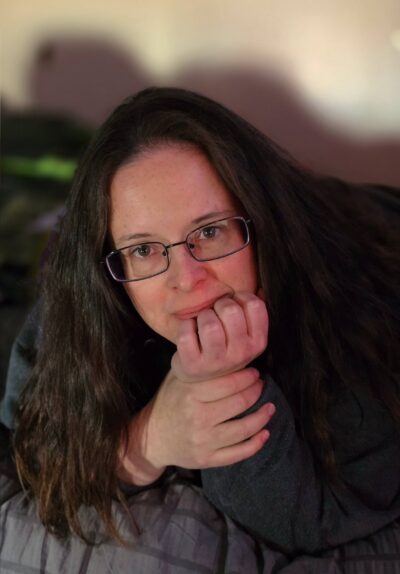
- Cynthia Hansford, she/her
Cynthia Hansford is a wife, mother, writer, educator, whose work centers on trauma, survival, and the long, nonlinear path toward healing. She explores the body’s memory, the cost of silence, and what it means to find your voice after years of not being able to use it. Her work includes The Monster I Trusted and and The Girl Who Kept Me Safe.