
Insight
Everything I Learned About Treating PTSD with Ketamine
The Good, the Bad, and the Unexpected Results of using Ketamine Therapy
A helpful way to think about trauma is as a violent physical injury.
Cracking your skull?
Blunt force trauma.
Medical professionals rescuing car crash survivors?
A trauma response team.
Bullet wounds?
Ballistic trauma.
But what about emotional trauma?
Let’s start with how our brains process trauma.
The brain is full of physical structures called neural pathways that carry information around. These help us process our experiences and develop ideas. When we see snow, our brains open the neural pathways that lead to all the ‘snow information’ we have stored away. Memories about cold and ice and snowmen and hats and gloves can be recalled in that instant, and we can form ideas about them. When we learn something new about snow, it gets added to the information we access when our brain uses neural pathways for “snow”.
The ability to build and maintain these pathways is called neuroplasticity.
But when something awful happens, something scary and horrifying and painful, our brains don’t know what to do with the new memories. That is emotional trauma— a sudden, violent injury to the way our brains process new information. This kind of trauma is also called Post-Traumatic Stress. When a traumatic event occurs, it can take time for our brains to figure out how to classify what happened to us. Often, we eventually build new neural pathways or successfully process the memory using existing pathways, and our brains resume pretty much their normal functioning.
Sometimes, though, our brains struggle to understand how to classify what happened to us. If this happens, the traumatic memory doesn’t get stored in the same way as other memories. If the brain doesn’t know what long-term associations to make with a traumatic event, our bodies can react as though the event is happening right now, not in a memory. This can feel like memory loss or personality changes. It can feel like depression. It can feel like brain fog. That’s when Trauma becomes Post-Traumatic Stress Disorder.
My Story
I was raped at 14 years old, and again at 20. After my first assault I became suicidally depressed, but I pushed through by suppressing my feelings. After my second assault, it was like the scar was ripped open. I had nightmares. I developed agoraphobia, a fear of crowds and leaving the safety of my own home. For over a decade, I went to therapy, trying to deal with symptoms. Mostly I lived with my PTSD the way many survivors do, by giving myself enough grace to survive episodes and by avoiding triggers.
Fifteen years later, my husband and sister died during the Covid pandemic. I recognized my fresh nightmares and panic attacks as PTSD, but as the months went on, my symptoms began to look less familiar. I developed an inability to speak that was brought on by the trauma I experienced. Soon I was forgetting what I was saying in the middle of a sentence, and couldn’t complete simple tasks. I felt like I was walking around in a constant fog. People told me it was grief, but I was sure it was more than that. I talked to my primary care doctor, and she sent me to a neuropsychiatrist.
I was not surprised to be diagnosed again with PTSD. What did surprise me was being diagnosed with Attention Deficit Hyperactivity Disorder (ADHD) and temporary aphasia caused by the trauma I experienced, measurable in tests as a brain injury. I told him I hadn’t hit my head, but he said that didn’t matter. Emotional trauma is a physical injury. You can even see it on PET scans. And like any physical injury, each time you get hurt again, it takes longer to heal.
Despite getting medication for my symptoms, I still struggled to get through each day. I started looking for other treatments, and that’s how I learned about ketamine therapy.
How Ketamine Therapy Works
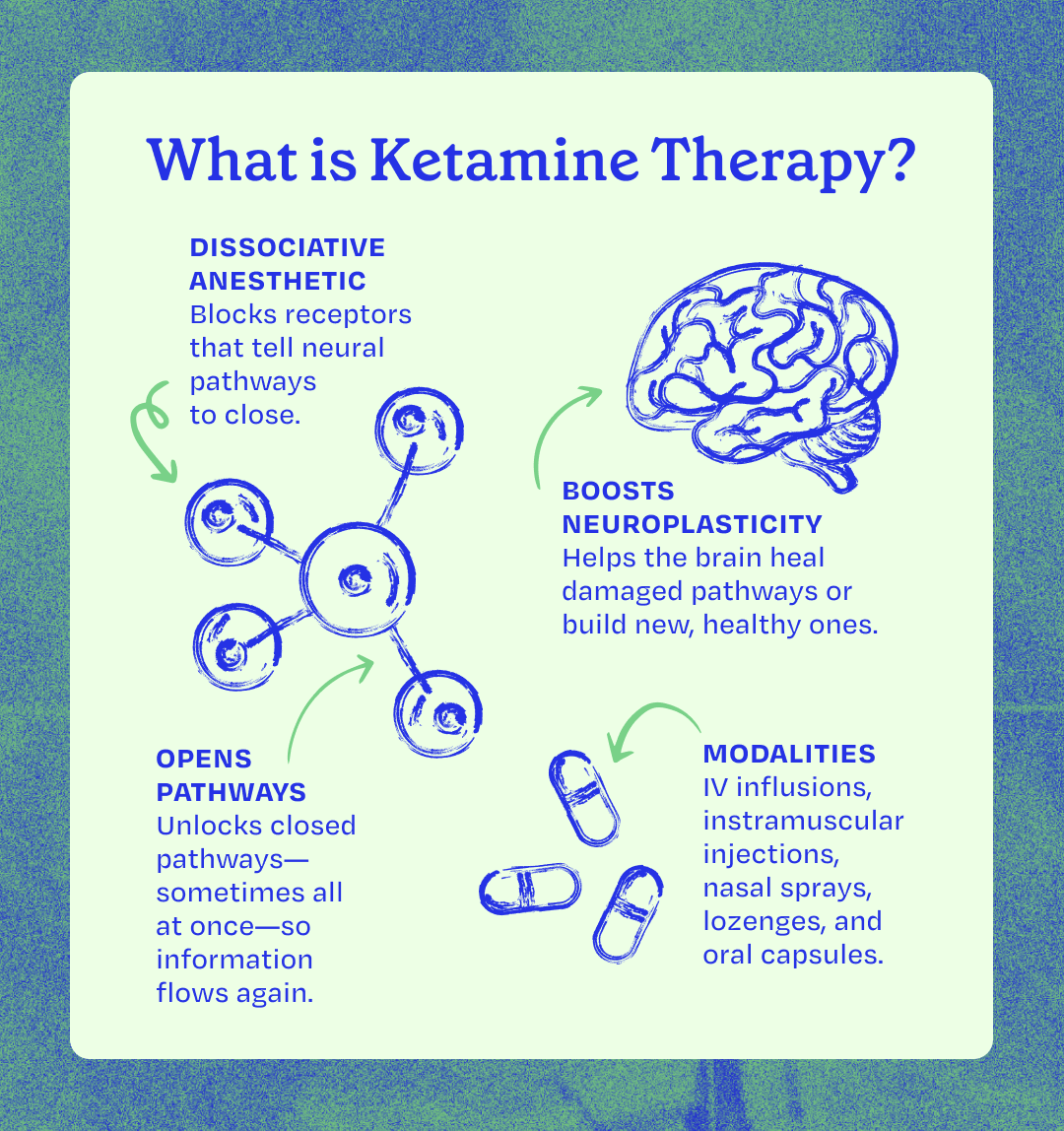
Ketamine is a kind of drug known as “dissociative anesthetics.” It works by blocking receptors in the brain that tell neural pathways to close. When the medication is administered, closed neural pathways open— sometimes all at the same time. Neural pathways that were shut down by PTSD can begin passing along information again. This increases the neuroplasticity in the brain, allowing it to heal damaged pathways or build new, healthy ones.
The word most commonly used to describe what people see and feel and interpret while the medicine is taking effect is, “psychedelic.” The psychedelic experience itself is pretty short- 45 minutes to 2 hours -but the increased neuroplasticity lasts for weeks. As soon as two months after a ketamine treatment, the brain is able to open and form new neural pathways much faster than before.
But here’s a challenge: when our brains open tons of closed pathways at the same time, we don’t get to choose what to focus on. We can’t aim ketamine at only pathways associated with one event - we have to dose the whole brain at once.
Ketamine treatments are typically six to twelve doses over the course of a few months. When I started exploring treatment options, the clinic’s nurse practitioner explained that ketamine treatment is like physical therapy for an injury- eventually the benefits could fade and I might need a few additional sessions to maintain my brain’s health. I started ketamine therapy with a prescription for six treatments, once every other week for six weeks, and then once a week for another three.
My Early Ketamine Experiences
For each session, I went to a clinic where a nurse administered my medicine through an IV. I reclined in a zero-gravity chair, blindfolded, wrapped in a warm blanket, wearing noise-cancelling headphones that played an ambient musical soundtrack to guide my brain in making emotional connections. At the end of each session, a clinic therapist helped me process what I experienced. Then they gave me a tray of snacks and took me to a room full of comfy pillows, yoga mats, and art supplies. I did yoga to get my muscles moving after sedation, ate something healthy after fasting for at least six hours before treatment, and visually interpreted my experiences to help my brain continue increasing neuroplasticity and build positive associations. After an hour or so, clinic staff made sure I had a friend to drive me home, and gave me instructions to stay away from social media, scary or sad movies and games, and heavy machinery. They gave me a journal to record what I experienced, full of prompts to record aspects of each treatment over the course of the following weeks. The next day I met with my therapist to discuss my experiences even more.
I went into my first session assuming the trauma I most needed to deal with was my husband’s death. Instead, my brain immediately made the connection that I hadn’t properly grieved my sister. My neural pathways carrying information about her had started shutting down in the year since she died while I was dealing with my husband’s cancer, the pandemic, and the needs of my children. But my sister had been part of my entire life. A huge amount of my identity revolves around being her younger sister. The trauma of losing her was like losing a massive piece of myself, and I had barely acknowledged the depth of that loss. Over the next few weeks, I focused on my feelings about losing her, and my cognitive symptoms began to improve.
I had four similar ketamine experiences after that. I could communicate better. I was able to focus more.
Each of those sessions ended with a lesson I could explain and focus on:
“I haven’t grieved my sister.”
“I can let go of one feeling and have another one.”
“I need to experience things that excite me to be excited about experiencing things.”
Experiencing the Risks of Ketamine
After my sixth session I realized I had been ignoring and avoiding thoughts and feelings that made me feel ashamed. During the following weeks of increased neuroplasticity, my brain opened every neural pathway connected to those thoughts. For six weeks I had no choice but to remember them every time I had thought something, and then be ashamed of myself for thinking it. I had to work through every memory until I accepted that it’s okay to have thoughts and feelings that reflect facts that make you uncomfortable. Sometimes it was simple, like remembering I said something thoughtless to a friend in middle school. Sometimes it was complicated, like feeling jealousy over my parents’ relationship with my siblings. Sometimes it was excruciating, like asking myself why I remained afraid to report my childhood sexual assault to the cops.
Over those weeks I became deeply depressed, even suicidal. I was able to come through it because I had a spectacular therapist on call, a roommate helping take care of my kids, and a lifestyle that gave me the flexibility to take time off for myself. The clinic checked on me and my depression symptoms twice, a week after my last session and three months after that. Unfortunately, In between, they didn’t provide me with any resources to get me through the aftermath of the treatment.
Navigating Ketamine Therapy to Make it Work for Me
A year after my sixth treatment, that clinic shut down. Ketamine practices come and go, and there is no consistency between the services providers offer. When I decided that I was ready for supplemental doses eighteen months after my first course of treatments, I found a new clinic.
Twice, a doctor administered intramuscular injections of ketamine. This clinic did not have therapists on staff, and I brought my own headphones, blindfold, and blanket. I was responsible for facilitating my neuroplasticity, and I prepared my space at home with snacks, art supplies, and cozy blankets and pillows. My therapist met with me the day after the sessions to help process my experiences, but I had to rely more on journaling to remember what I had seen or felt.
Two years after that I sought out treatments again, this time at a remote clinic. Since they didn’t have a method for sharing records with other providers, they made me start a full course of six treatments. They shipped medication and supplies to my home, where I administered the subcutaneous injections myself. A friend sat nearby to make sure I was safe. The clinic provided a remote therapist for only two sessions. They also provided a journal and an app to help patients understand and record what they experienced. The app was full of suggestions for ways to increase neuroplasticity through art therapy, support groups, and a series of videos on utilizing treatments.
Ketamine is an Unpredictable and Powerful Drug
When people like me describe ketamine as a miracle drug, we’re not exaggerating. The dramatic effectiveness of my treatments was like putting on glasses and seeing leaves on the trees for the first time. It changed my life, and I cannot say that strongly enough.
When people like me describe ketamine as dangerous and unpredictable, we’re not exaggerating. The effects of this treatment cannot be controlled. There’s no way to know if any given treatment will help or harm, if you’ll come out of it with solutions, or a list of new problems. I made the decision to pursue ketamine therapy even after the session that left me nearly suicidal, because I knew how successful even that session had turned out to be, and because I knew I had the support network in place to help me if it happened again.
I thought I wasn't going into this therapy naively. While I understood there were risks involved, there was a lack of information about what experiencing those outcomes could actually be like. "May cause depression or increased risk of suicide" isn't the same as, "May cause months of flashbacks to traumatic events." Though extreme, I knew that my own negative experience was not the worst that could happen. People have and do succumb to suicide during and after ketamine therapy, and there are risks of permanent injury beyond PTSD.
And perhaps most significantly, it is important to understand that there is no consistency between clinics—not in the way they administer medication, not in the way they provide care, and not in the way they help you process your experiences. ven so, my negative experience didn’t come from a neglectful practice or insufficient resources, it came because that was how my brain happened to respond when all its neural pathways opened up.
If you are considering ketamine therapy, talk to your therapist. Make sure you are prepared for your symptoms to get worse before they get better. Make sure your support network knows you might be moving into a crisis and is prepared to help. If you don’t have a good support network in place, start to build one. Learn all you can about how to build neuroplasticity, and plan to do that work at the same time as using the medicine.
Building a support network and fostering your neuroplasticity are helpful no matter what. There is no one right way to heal. And most importantly, knowing experts are always developing new ways to treat PTSD can make a difference all by itself. We are always learning, and always learning to help each other.
INSIGHT DISCLAIMER
Insight articles are written by survivors sharing their own first-hand healing knowledge and lived experience. These are personal perspectives featuring survivor-to-survivor wisdom, advice, and offering firsthand accounts of navigating the challenges/realities faced by survivors. Every survivor’s journey is different. Braver Collective does not endorse, approve, or recommend any specific path or modality towards healing. All content on this page (written, visual, linked) is for educational purposes only, and is not intended to replace or provide medical, legal, or any professional advice or care. Always consult a qualified healthcare professional for any health-related questions, concerns, or conditions. If you are experiencing a medical emergency, dial 911 or go to the closest emergency room.
- Lea Grover
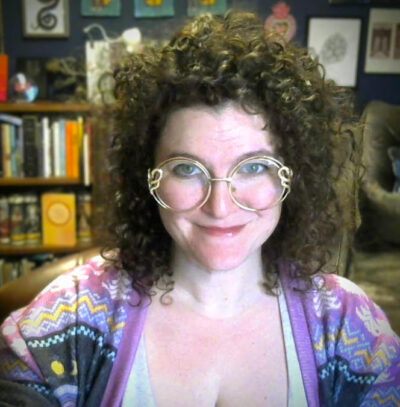
Lea Grover is a writer and speaker in the Chicago suburbs. In 2010, she began writing for the Chicago Tribune on the ChicagoNow platform. On that blog, Becoming SuperMommy, she chronicled her late husband Michael Grover’s brain cancer, and their family's experience. In addition to writing about life with cancer, she's a member of the RAINN Speakers Bureau, a freelance writer taking on issues related to sexual violence prevention, and formerly worked as a staff writer for World Without Exploitation. Her memoir of the years leading up to her time writing for the Tribune, defined by sexual violence and her then-fiancé's terminal diagnosis, is coming out this spring-- "When and Always: A Love Story of Disease and Madness".