
Resource
When Healing Hurts:
Why EFT Worked for Me (when EMDR Didn’t)
Healing is not one-size-fits-all.
I know that’s not a revolutionary statement, but it’s one that needs to be said louder, especially in a world that keeps prescribing the same modalities to every trauma survivor like we’re all built from the same blueprint.
We’re not. We’re complex. We’re layered. We carry different wounds, survival responses, nervous system imprints, and lived experiences.
And sometimes, the healing tools that help others can actually retraumatize us.
That’s what happened to me with EMDR.
EMDR, short for Eye Movement Desensitization and Reprocessing, is a type of therapy where you bring up a painful memory while doing something like following a therapist’s finger back and forth with your eyes. The idea is that this bilateral stimulation (stimulating two different parts of the brain at once) helps your brain reprocess the memory so it doesn’t hold the same emotional charge anymore. For some people, especially those with a single traumatic event, it can work really well, almost like helping the brain “file away” a memory that got stuck.
That’s why so many therapists recommend EMDR. But for those of us with complex trauma, dissociation, or internal fragmentation, it can be too much, too fast. For me, it didn’t leave room for the layered, nonlinear nature of my healing. Instead of integration, I felt disoriented and unsafe. The same intensity that can be effective for others left me feeling fragmented. My system didn’t need confrontation, it needed compassion.
When “Evidence-Based” Doesn’t Fit the Whole Picture
Let me be clear: I’m not here to bash EMDR. For many people, especially those navigating single-incident PTSD, it can be a powerful, effective tool. But when it comes to C-PTSD, the waters get murkier.
PTSD often stems from one event.
C-PTSD stems from what felt like every day for decades.
That distinction matters.
Because when your entire body is built around surviving prolonged trauma: like abuse, neglect, or systemic harm, your nervous system doesn’t just hold one memory. It holds patterns. Layers. Triggers that live in your daily life.
I had already found EFT (Emotional Freedom Techniques) when I was introduced to EMDR. And while EFT was gentle and regulating for me, EMDR felt like being thrown into the deep end without a life jacket.
I now understand that part of the harm I experienced with EMDR may have also been due to my dissociative identity structure - meaning I have distinct parts or “selves” within me that hold different memories, emotions, and survival roles as a result of prolonged trauma. EMDR moved too fast. It didn’t account for the internal complexity of my system. I left sessions feeling fragmented, ungrounded, and emotionally unsafe.
For some of us, especially those with complex trauma and dissociation, tools that prioritize exposure or memory reprocessing can actually do more harm than good, even if they’re considered “evidence-based.”
Healing isn’t one-size-fits-all.
And that’s not a flaw in you or the tool. It’s just a sign that your nervous system may need a different approach.
What Is EFT?
EFT (Emotional Freedom Techniques), also called “tapping,” is a gentle, somatic-based tool that combines focused attention on emotional challenges with light tapping on acupuncture points. It helps reduce distress in the nervous system while keeping you grounded in the present moment.
It sounds simple, and it is, but the impact can be profound.
You don’t have to relive your trauma. You don’t have to reprocess memories your body isn’t ready for. You can start exactly where you are: anxious, numb, dissociated, spiraling, or simply surviving.
And it works with you, not against you.
Why EFT Worked for Me
EFT met me where I was.
It didn’t push. It didn’t pressure. It gave my nervous system permission to exist in survival, without shame, and slowly, with time, helped it find safety again.
I didn’t need to talk through my trauma in a linear way (because, let’s be honest, complex trauma is never linear). I could just notice how my chest felt tight when I thought about abandonment. Or how a wave of shame would rise when I spoke about anger.
And in those moments, I had a tool in my hands, literally.
A Growing Body of Research
If you’re someone who needs science to feel safe (hi, me too), here’s some good news:
Research shows that EFT can significantly reduce cortisol levels (your body’s main stress hormone). One study found a 24% drop in cortisol after just one hour of tapping, compared to a 14% drop in talk therapy and no significant change in a control group.
Clinical studies have also shown that EFT can reduce symptoms of PTSD, anxiety, and depression, often with fewer sessions than traditional therapies require.
There’s now enough research for EFT to be recognized as an "evidence-based practice" by organizations like the APA Division 12 Task Force and the U.S. Veterans Administration.
What Does EFT Actually Look Like?
So what does tapping actually look like in practice?
Let’s say you’re feeling overwhelmed: your chest is tight, your thoughts are racing, and your body’s on edge. With EFT, instead of pushing that feeling away or trying to fix it, you gently meet it.
You begin by tapping on the side of your hand while saying something like:
“Even though I feel really overwhelmed right now, I accept myself and how I feel.”
Then you’d tap through a sequence of points on your body, lightly using your fingertips while repeating short, honest phrases that name what you’re feeling.
These points include:
- Eyebrow (where your brow starts near your nose)
- Side of the eye (on the bone next to your temple)
- Under the eye (on the bone directly below the eye)
- Under the nose
- Chin (the dip between your lower lip and chin)
- Collarbone (just under the circular bone, about an inch down)
- Under the arm (about four inches below your armpit)
- Top of the head
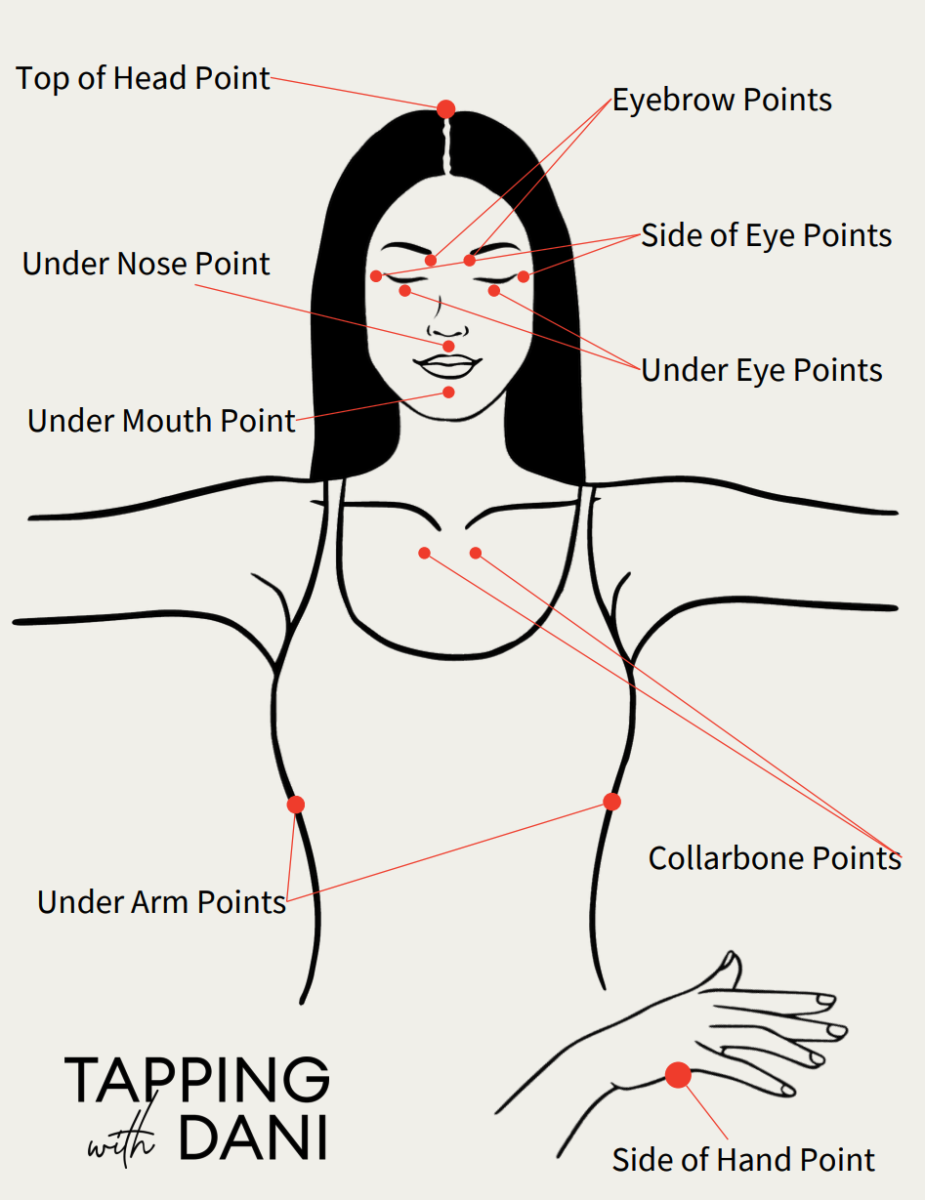
To tap, use two fingers (usually your index and middle finger) and gently tap each point about 7 to 10 times. You want to use enough pressure to feel the sensation, but not so much that it’s uncomfortable or hurts. Think of it like a rhythmic, respectful nudge, just enough to get your body’s attention without overwhelming it. And if the act of tapping feels overstimulating or uncomfortable, that’s okay too, you can gently press on each point instead. The most important thing is that it feels safe and doable for you.
You don’t need to get it perfect. What matters most is being present with whatever you're feeling and gently naming it as you tap. You might say things like:
“This tight feeling in my chest.”
“All this anxiety that won’t let go.”
“I don’t feel safe, and I hate that I feel this way.”
“It’s okay to feel this. I’m here with it now.”
As you tap, something powerful happens: your body starts to shift out of fight-or-flight mode. The tapping sends calming signals to the brain, telling your nervous system that it’s safe to slow down. You’re still acknowledging the hard feeling, but your body no longer thinks it has to run from it or shut down. That’s the magic of EFT: it helps your system feel safer in the moment, not just later.
Some people feel a shift right away: a deeper breath, a bit more calm in their body, or a slight release of tension. For others, it might take a few more rounds of tapping before anything starts to settle. That’s completely normal. There’s no “right” way to feel. Tapping isn’t about forcing results, it’s about building safety, one small signal at a time.
If You’ve Been Harmed by Healing, You’re Not Alone
I wish someone had told me it was okay to walk away from a therapy that wasn’t working. That doing so didn’t make me weak or resistant or uncommitted to healing.
If you’ve ever felt like healing tools were hurting more than helping, this is your reminder: it’s not your fault. Your nervous system isn’t broken. It just needs something different.
That’s why I created a free EFT guide, for people like us.
People who need healing that feels safe, empowering, and self-paced.
Click here to download the Free EFT Guide
Inside, you’ll find:
- A beginner-friendly breakdown of what tapping is
- Step-by-step instructions on how to do it
- Tips for making it your own
Whether you’re brand new or just EFT-curious, it’s a free resource designed to help you start regulating your nervous system in a trauma-informed way.
You deserve that.
You deserve tools that work with your body, not around it.
And more than anything, you deserve to heal on your own terms.
RESOURCE DISCLAIMER
Resource articles are researched and written by experts and advocates in the field of survivor support. Every survivor’s journey is different. Braver Collective does not endorse, approve, or recommend any specific path or modality towards healing. All content on this page (written, visual, linked) is for educational purposes only, and is not intended to replace or provide medical, legal, or any professional advice or care. Always consult a qualified healthcare professional for any health-related questions, concerns, or conditions. If you are experiencing a medical emergency, dial 911 or go to the closest emergency room.

- Danielle Carpio, she/her
- EFT Practitioner + C-PTSD Advocate
Danielle Carpio is a C-PTSD advocate, survivor, and the founder of Healing and C-PTSD, a community for complex trauma survivors. A certified EFT Practitioner and trauma educator, Danielle creates survivor-centered tools that support nervous system regulation and emotional healing. She believes in burning toxic healing narratives to the ground and building something better—something that actually works for those of us with complex trauma.
Links:
www.healingandcptsd.com
www.complexdani.com
www.tappingwithdani.com