
Insight
5 Tips For Navigating Your Workplace as a Survivor
Practical Tips on How to Make it Through Your Work Day in Corporate America
Have you ever been working and realize you’ve just been blankly staring at your screen for an unknown amount of time?
When you snap out of it, you ask “Wait… How long was I staring at that screen? Did something happen? Did someone see?” “Why can’t I focus? Why do I feel so anxious? I have my tea and my cozy sweater on…”
It took me so long to understand what was happening and never did I think to associate my brain fog, lack of focus, and imposter syndrome to my trauma as a survivor of child sexual abuse (CSA). I deeply understood how my trauma was impacting my personal life, but I didn’t realize that my triggers and somatic responses affected my day-to-day productivity at the office. And all of these challenges were amplified by the uninformed setup of my workplace. It was a connection I didn’t think to make.
My body was trying to tell me something in those moments I was staring aimlessly at a screen. But, see, my trauma response going all the way back to childhood is to freeze. That is my response. We all have a few of these mechanisms, which I’m sure you’ve heard before—fight, flight, freeze and/or fawn. Since my early response was “freeze,” that’s what I did into adulthood. I froze right in front of my computer, disassociated and unable to move. By the time I snapped out, I didn’t know what had or hadn’t happened.
So, how can I be productive if my body is freezing on and off all day?
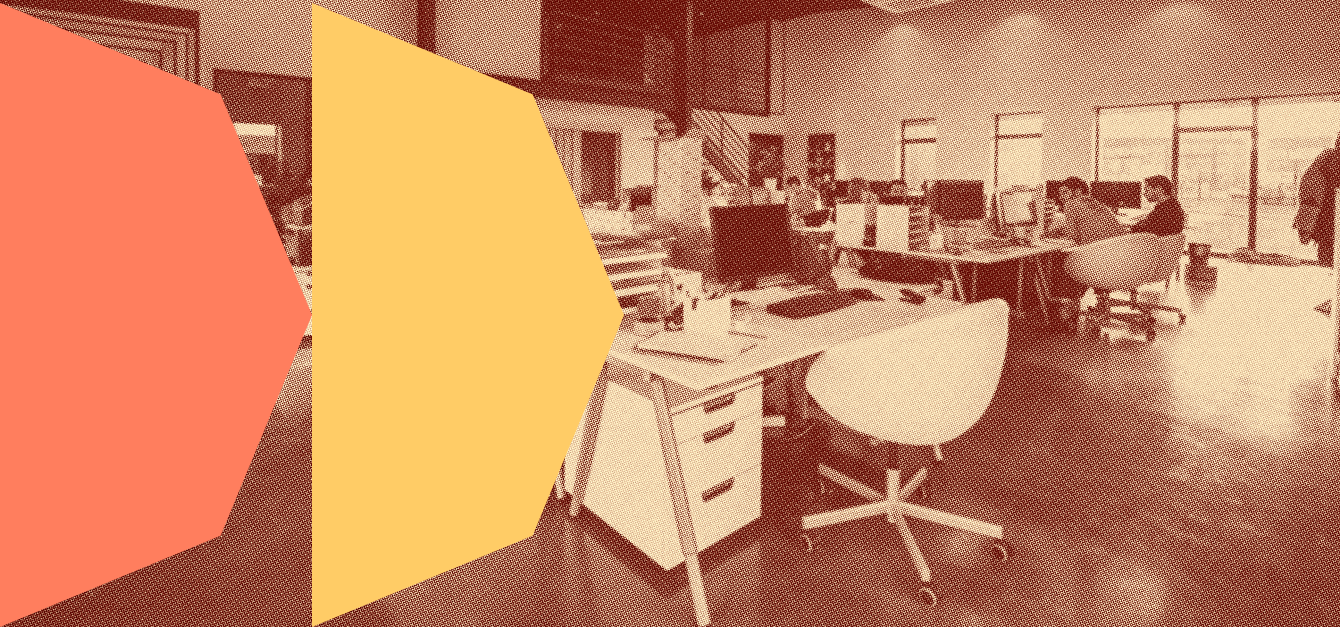
My “Collaborative” Workplace was Covertly Causing Me to Freeze.
The trick was trying to understand why I was freezing. I was safe, in a high tech office building with bright light, lots of coffee and tea, and co-workers who were also friends. But somehow, none of that mattered to my body. It still felt triggered. So why was this happening? Any guesses? And no, it wasn’t the workload (haha!) - I learned it was my physical environment—the beloved open floorplans that are supposed to be collaborative and innovative. And I’m sure they are for some folks. But for my brain and body, which were constantly scanning for danger, the open floorplan was not the best setup. I was constantly on high alert - you can’t be productive if your body feels like it’s in danger.
As I was navigating my body’s triggers during work hours, I was also undergoing EMDR therapy in a small San Francisco office downtown. EMDR helped me learn how to identify my body’s somatic responses. This takes quite a bit of listening: not the listening you do with your ears, but the listening we usually ignore from our gut. It takes patience and practice. But, once you can hear what your body needs, you can respond accordingly and do what you need to get through that moment.
Over time, the somatic learning I did during EMDR therapy helped me find ways to navigate the workplace in a less triggered state. I want to share the practical tips I learned to help my body adjust to its environment and set myself up for long-term resilience.
Each tip is paired with journaling prompts to help you build your own plan for thriving in the workplace/office as a survivor.
I identified 5 things that help me avoid freezing at work.
Tip 1: Build your surroundings
Be intentional about your physical space, and don't be afraid to change it up when you need to.
So many things can be triggering at work — toxic environments, microaggressions, high-stress situations. Our nervous systems are always scanning for danger, and if you're a survivor, that antenna may be on overdrive. When you feel yourself getting activated, one of the simplest things you can do is physically move your body to a different space. A change of scenery — stepping away from your desk, sitting somewhere quieter, even just moving to a different chair — can interrupt that triggered state and signal to your body that it has options. If you can step outside for a moment, even better.
Being intentional about where you place yourself, and giving yourself permission to move when you need to, helps your body feel less trapped and more in control.
JOURNAL PROMPTS
- Think about a space where you feel most at ease — at work or elsewhere. What is it about that environment that helps your body feel safe and settled?
- Now think about your current workplace: Where is one place you could go to or what's one small, realistic change you could make to make it feel more like that?
—
Tip 2: Identify resources + strategies to help you calm quickly
Sometimes you can't move — you're in a meeting, on a call, or in a shared space with nowhere to go. That's where resourcing comes in. This has been one of the most helpful things I’ve added to my toolbox from my EMDR therapy. In EMDR, resourcing refers to building internal coping mechanisms to help manage emotional distress. There are lots of different ways to do this — for me, having tangible tools within arm’s reach helped me engage my senses, ground my physical self, and bring my attention back to the present moment.
Think about things you can actively touch, taste, or smell that bring you comfort — a candle, a hot cup of tea, an essential oil, something soft, a small sweet treat. These aren't just comforting objects; they're intentional anchors. When something on a call or in a conversation sends you into a triggered state, reaching for one of these can help your body remember that you are safe, right here, right now.
Being intentional about what you keep close — not just where you are — means you're always prepared to come back to yourself quickly.
JOURNAL PROMPT
- What objects can I keep nearby at work that will bring me comfort when I feel triggered?
—
Tip 3: Identify your vulnerable side
Know your triggers before they know you.
One of the most powerful things EMDR therapy helped me uncover wasn't just what triggers me, but how and where my body receives that trigger. Through my own EMDR work, I discovered that my right side is a vulnerability for me — meaning that when someone is positioned to my right, my nervous system activates in a way that can send me into a triggered state before my brain has even had a chance to catch up.
Once I knew that, everything changed. Instead of wondering why I suddenly felt unsafe or dysregulated in certain situations, I had actionable information. I could walk into a meeting and intentionally choose a seat that kept people off of my right side. It sounds simple, but that one small adjustment gave me back a sense of control.
This is worth exploring in your own healing work — whether through EMDR, somatic therapy, or another modality. Your vulnerable side may not be physical at all; it might be a tone of voice, a specific type of feedback, or even a particular time of day when your capacity is lower. The goal is to get curious about your patterns rather than being blindsided by them. When you can name what's happening in your body and understand why, you shift from reacting to responding. That awareness is one of the most practical tools you can carry into any workplace.
JOURNAL PROMPTS
- Are there specific situations, spaces or people that I feel uneasy/triggered around at work?
- How do I experience these triggers in my body?
- What adjustments could I make to my body, my personal space or my boundaries that can help me feel less vulnerable?
—
Tip 4: Take breaks, lots of them
Give yourself permission to rest — your resilience depends on it.
This can be surprisingly hard. In high-pressure work environments, taking a break can feel like a luxury, an indulgence, or even a sign of weakness. If you're also managing a heavy workload, stepping away might feel impossible. But here's what I want you to understand: for survivors, breaks aren't optional — they're maintenance.
Our nervous systems work harder than most. When you're constantly scanning for danger, managing triggers, and working to stay regulated and present, your body is carrying an enormous amount of emotional & cognitive weight alongside your actual job. Without intentional recovery time, that load accumulates, and over time it can push us well outside our window of tolerance — the space where we're able to function, process, and cope effectively.
A break doesn't have to be long. It can be five minutes of stepping outside, a short walk, a quiet moment with your eyes closed, or even just sitting somewhere away from your screen. What matters is that you're giving your body a signal that it's okay to soften, even briefly. Over time, these small moments of recovery are what build lasting resilience — not pushing through at all costs.
Reframe breaks not as time away from your work, but as a tool to help you approach your work more intentionally.
JOURNAL PROMPTS
- I know I need a break when my body starts to feel like…
- I know I need a break when I start to think about…
- I know I need a break when I start to respond like…
- Map out what an ideal break looks like for you. What if it is 30 minutes? 15 minutes? 1 minute?
—
Tip 5: Set starting + closing rituals
Teach your body where work ends and the rest of your life begins.
One of the challenges of being a survivor in the workplace is that our nervous systems don't always get the memo when the workday is over. You close your laptop or leave the office, but your mind is still in that tense meeting. You're trying to be present with the people you love, but part of you is still activated, still processing, still braced for something. Racing thoughts and residual stress can bleed well into the evening if we don't actively create a transition.
This is where a closing ritual becomes essential. In EMDR therapy, closure is a deliberate part of every session — therapists use it to help your nervous system return to a baseline state before you leave, so you're not walking out still wide open and activated. We can apply that same principle to our workday.
A closing ritual is simply a consistent, intentional routine that signals to your body: we are shifting now. It doesn't need to be elaborate. It might look like tidying your workspace, writing down your to-do list for the next day so your brain can release it, taking a few slow deep breaths, doing a short walk, or even just changing out of your work clothes. The consistency is what makes it work — over time, your nervous system begins to recognize these cues as a transition point, and it becomes easier to actually leave work at work.
A starting ritual can serve a similar purpose in the morning — helping you arrive into your workday with intention rather than being immediately swept into a reactive state. Think of it as consciously opening and closing the container of your workday, so that what happens inside it stays inside it.
JOURNAL PROMPTS
- How do I currently start and end my work day?
- An ideal start and end to my work day includes…
Build a Structure that Works for You.
These tips together — being intentional about your surroundings, identifying what calms you, knowing your triggers, honoring your need to rest, and creating rituals around your day — are about building a structure that supports your nervous system from the inside out. You deserve a workday that works with your body, not against it.
Of course, there are other strategies and helpful tips out there that can help survivors, but I wanted to share my experience because these have proven effective for me. Still, I cannot stress enough that one size does not fit all. Just because it worked for me does not guarantee that it will work for you. All of our experiences vary, so the most important thing is to listen to YOUR body and see what resonates. As a survivor, I want to help put you in a position of power and control. Knowledge is power, and if you can set yourself up with long-term resilience, you can handle not only these situations, but many others that will turn you from vulnerable to powerful.
INSIGHT DISCLAIMER
Insight articles are written by survivors sharing their own first-hand healing knowledge and lived experience. These are personal perspectives featuring survivor-to-survivor wisdom, advice, and offering firsthand accounts of navigating the challenges/realities faced by survivors. Every survivor’s journey is different. Braver Collective does not endorse, approve, or recommend any specific path or modality towards healing. All content on this page (written, visual, linked) is for educational purposes only, and is not intended to replace or provide medical, legal, or any professional advice or care. Always consult a qualified healthcare professional for any health-related questions, concerns, or conditions. If you are experiencing a medical emergency, dial 911 or go to the closest emergency room.

- Karina Davila
Karina Davila is a designer, researcher, artist, and writer whose life and work are shaped by her experience as a survivor of child sexual abuse. She channels that truth into advocacy, education, and healing—believing deeply in the power of design and storytelling to shift culture, spark conversation, and create the conditions for genuine connection and safety.
Her work sits at the intersection of human behavior, design, and social impact, with a focus on prevention, consent and boundaries. Most notably, she led UX design and research at Thorn, a tech nonprofit dedicated to detecting and removing child sexual abuse material—work that sits especially close to her heart as a survivor. Her broader career includes organizations such as UNICEF, The National Democratic Training Center, and Visa.
Currently, she is focused on community-led design projects exploring how prevention and boundary-setting can be woven into experiences that bring people genuinely closer together.
As an artist and writer, she uses visual and written storytelling to process and share her experience—turning personal history into work that resonates with fellow survivors and opens doors for those still finding their way. Outside of this work, she is a parent to a toddler, a yoga teacher, a calligrapher, and someone who finds restoration in running, kayaking, and hiking—usually with a cat and dog nearby.